Midweek Inspiration

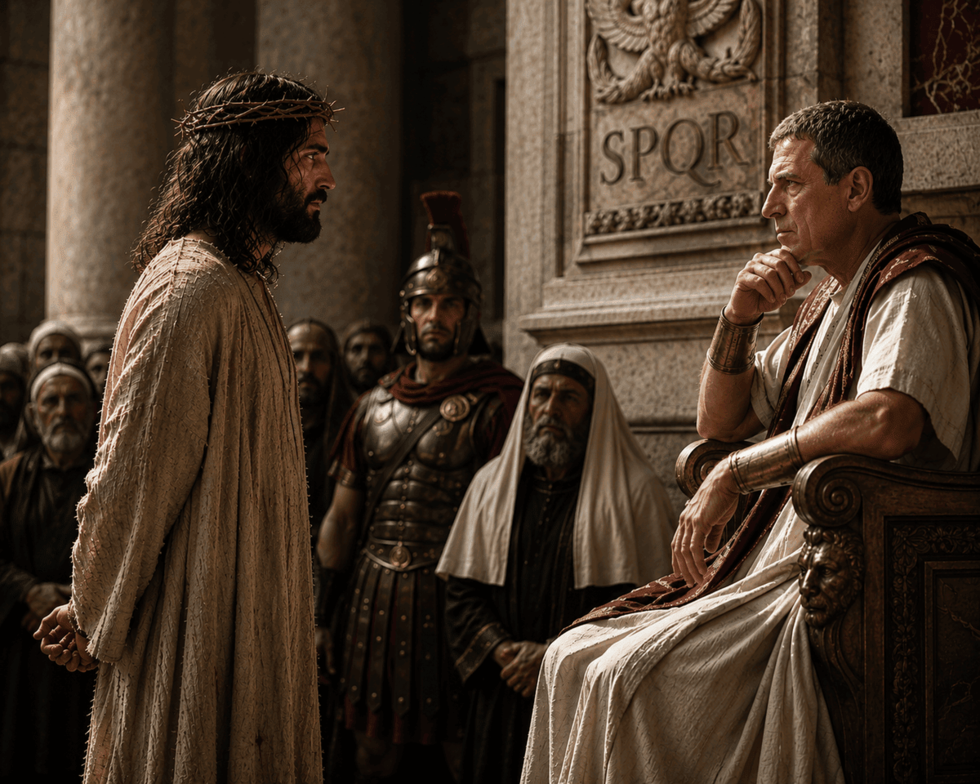
Pontius Pilate, the Roman governor who ordered the crucifixion of Jesus, once asked a question that continues through every generation: “What is truth?” (John 18:38).
In many ways, Pilate’s question prophetically describes the current condition of humanity. Our culture is increasingly uncertain about whether absolute truth even exists. Outside of a biblical worldview, truth is often treated as subjective, personal, and fluid. People speak of “my truth” and “your truth,” as though truth changes according to our feelings, experiences, desires, or circumstances.
But when truth is constantly changing, it eventually loses its meaning.
What was once clearly recognized as wrong is now celebrated as acceptable. What was once considered destructive is now defended as personal freedom. Convictions shift with the winds of culture, and morality is constantly redefined. Yet this kind of truth is no truth at all. It may offer temporary comfort, but in the end, it produces instability, confusion, and bondage.
Feelings are real, but feelings are not always truthful. Opinions can be sincere, but sincerity does not make an opinion correct. Society may approve of something, but cultural acceptance does not make it righteous. Truth cannot be determined by popularity, emotion, or majority vote.
Truth must rest upon something greater than us.
As Christians, we do not believe that truth is merely an idea or a collection of religious principles. We believe that truth is ultimately revealed in a Person.
Jesus did not say that He knew one possible truth among many. He did not say that He had discovered His own personal truth. He said in John 14:6, “I am the truth.”
Truth is found in the character, words, and work of Jesus Christ. He is the visible revelation of the invisible God. He shows us who God is, what righteousness looks like, what love truly means, and how sinners can be reconciled to their Creator.
We also find truth in the Word of God. Jesus prayed to the Father in John 17:17 and said, “Sanctify them by Your truth. Your word is truth.”
The Bible does not adjust itself to fit every generation. Instead, every generation must examine itself in the light of Scripture. God’s Word stands firm when cultures change, governments fall, opinions shift, and human philosophies fade.
Psalm 119:160 declares, “The entirety of Your word is truth, and every one of Your righteous judgments endures forever.”
This does not mean Christians always understand everything perfectly. We must approach Scripture with humility, prayer, and a willingness to be corrected. But our confidence is not in our own wisdom. Our confidence is in the God who has spoken.
Truth is not always comfortable. Sometimes it confronts us. Sometimes it exposes sin, challenges our desires, and calls us to repentance. But the truth does not confront us in order to destroy us. God reveals truth in order to rescue us.
A lie may comfort us temporarily, but only the truth can set us free (John 8:32). Truth frees us from deception, guilt, shame, false identities, empty philosophies, and the power of sin. It leads us away from darkness and into the glorious light of Christ.
Pilate asked, “What is truth?” while the Truth Himself was standing directly in front of him.
The tragedy is that many people are still doing the same thing today. They are searching for truth in politics, entertainment, relationships, social movements, education, personal feelings, pleasure, and human philosophies, while rejecting the One who declared Himself to be the Truth.
Church, we must not be ashamed of the truth. We must speak it clearly, live it consistently, and communicate it lovingly. We are not called to use truth as a weapon to crush people. We are called to speak the truth in love, pointing people to the grace and salvation found in Jesus Christ.
The world may continue to try and redefine truth, but God’s truth has not changed. Jesus Christ is still Lord. Sin is still destructive. Grace is still available. The cross is still sufficient. The tomb is still empty. And everyone who calls upon the name of the Lord will still be saved.
When Pontious Pilate asked, “What is Truth?” It was in response to what Jesus declared to him. Jesus said in John 18:37, “You say correctly that I am a king. For this purpose I have been born, and for this I have come into the world: to testify to the truth. Everyone who is of the truth listens to My voice.”
If you are of objective truth, not your truth or someone else’s truth, but of His truth you can hear Him and respond accordingly. Can you hear Him speaking to you today? He stands at the door and knocks. Will you open and invite Him in?
If you do, like so many have already done, you will experience the Truth and have your worldview change forever. Don’t be like Pontious Pilate who had truth standing in front of him and could not recognize it. Respond and live in the Truth of Jesus Christ!
In His Love,
Pastor Lu